
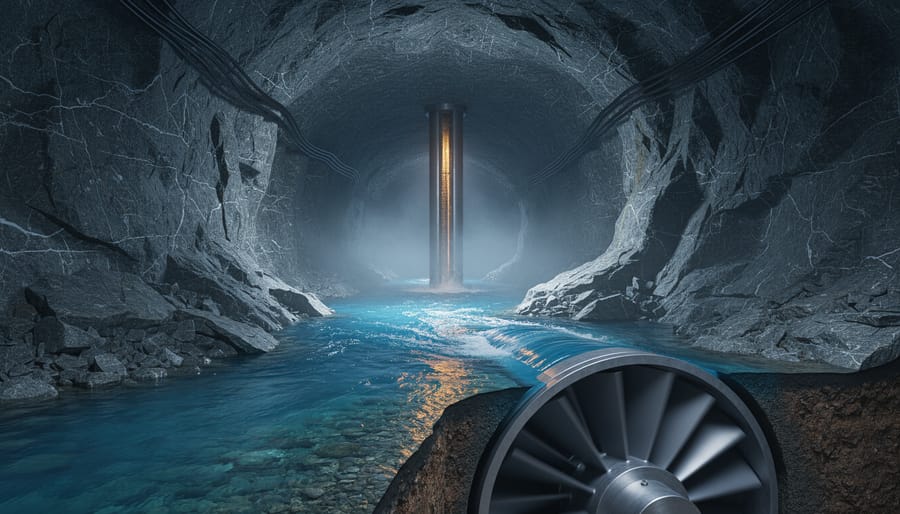

Canada’s five primary renewable energy resources are hydroelectric, wind, solar, geothermal, and biomass power, and what most people don’t realize is that each depends on sophisticated underground infrastructure to function reliably. From the massive tunnels channeling water to hydroelectric turbines to the buried transmission lines carrying wind energy across provinces, the invisible network beneath our feet makes renewable energy possible at scale.
Right now, hydroelectric power dominates Canada’s renewable portfolio, generating roughly 60% of the nation’s electricity through systems that rely heavily on penstock tunnels, underground powerhouses, and subterranean water diversions. Wind energy follows as our fastest-growing sector, but those towering turbines you see along Highway 401 or across Alberta’s prairies connect to an extensive grid of underground spaces used for transmission cables and substations. Solar installations, particularly large-scale solar farms in Ontario and Saskatchewan, depend on buried conduit systems. Geothermal projects tap into Earth’s heat through boreholes that can reach several kilometers deep. And biomass facilities often incorporate underground storage for feedstock and waste management.
Understanding these five resources means looking beyond the visible technology. The turbines, panels, and generators are only half the story. The real engineering marvels live underground: the rock tunnels carved through the Canadian Shield for hydroelectric projects, the directional drilling that places wind farm cables without disrupting farmland, the vertical geothermal wells pioneered in places like Regina. This infrastructure represents billions in investment and decades of planning, yet it remains largely unknown to the communities it serves.
This article explores each renewable resource through the lens of what lies beneath, revealing how underground engineering shapes Canada’s energy transition and how you can engage with these projects in your own region.
Geothermal Energy: Harnessing Heat Beneath Our Feet
How Underground Access Makes Geothermal Possible
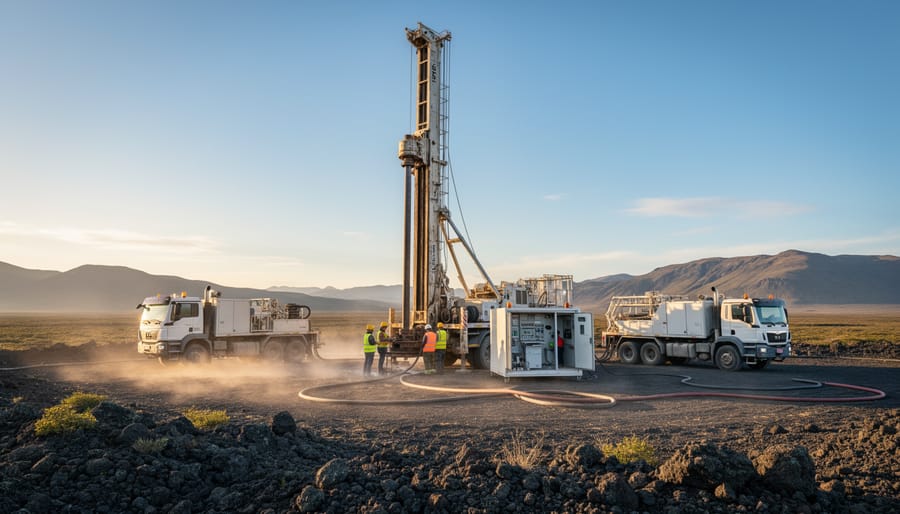
Accessing geothermal heat isn’t as simple as digging a hole. Reaching the Earth’s temperature gradient requires precision drilling that extends hundreds or even thousands of metres below the surface. For shallow ground-source heat pumps, crews drill boreholes 30 to 150 metres deep, installing closed-loop pipe systems that exchange heat with stable underground temperatures. Deep geothermal projects demand far more: vertical wells penetrating two to five kilometres into bedrock to tap reservoirs where temperatures exceed 150°C.
Canada’s decades of experience in tunneling through bedrock translates directly to geothermal development. The same rotary drilling rigs used in mining exploration bore through the Canadian Shield’s granite and gneiss, while directional drilling techniques perfected in oil and gas fields now guide geothermal wells through complex geology. In sedimentary basins across Alberta and Saskatchewan, existing oilfield infrastructure provides a head start, with abandoned wells being repurposed for geothermal heat recovery.
Natural Resources Canada’s research into deep geothermal in Canada highlights how our underground construction expertise positions us to lead this sector. From directional drilling that navigates around faults to cementing techniques that seal wellbores against high-pressure fluids, every stage relies on underground skills honed through generations of Canadian resource extraction and infrastructure projects.
Canadian Geothermal Projects Leading the Way
Several Canadian communities are proving that geothermal energy isn’t just theoretically promising, it’s delivering real results right now. These projects demonstrate how underground innovation can transform local energy systems while creating lasting community benefits.
The town of Estevan, Saskatchewan, made headlines with Canada’s first deep geothermal power project. Engineers drilled over 3,500 meters into the Prairie Basin, accessing heat from ancient sedimentary rock formations. This pilot facility now generates electricity for the local grid while providing data that’s helping communities across the Prairies evaluate their own geothermal potential. Local residents have embraced the project, seeing it as a way to diversify an economy historically tied to fossil fuels.
In British Columbia, the Tu Deh-Kah Geothermal project near Fort Nelson represents a different approach. This facility taps into naturally occurring hot springs through carefully positioned wells, providing clean heat to nearby industrial operations. The project reduced the community’s reliance on natural gas while creating jobs in drilling, maintenance, and monitoring, skills that overlap with the region’s existing energy workforce.
Meanwhile, Ontario’s Enwave Deep Lake Water Cooling system in Toronto, though technically a cooling rather than heating application, showcases how subsurface resources can serve urban centres. The system draws cold water from 83 meters below Lake Ontario’s surface, cooling downtown buildings far more efficiently than conventional air conditioning. It’s saved the equivalent of 79 megawatts of electricity, enough to power 40,000 homes.
These projects share a common thread: they’ve turned underground resources into community assets, demonstrating that Canada’s geothermal future is already taking shape beneath our feet.
Hydroelectric Power: The Underground Network
Tunnels That Power Provinces
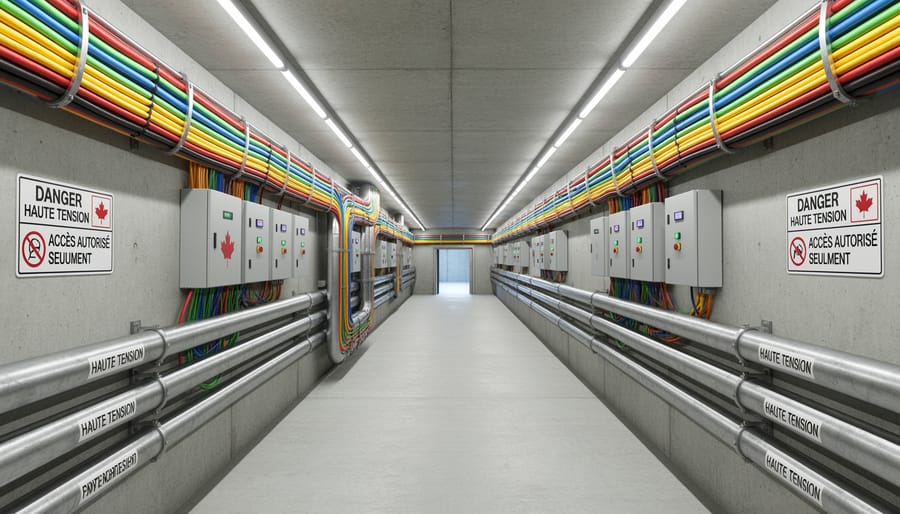
Canada’s hydroelectric infrastructure depends on tunnel networks that rival entire subway systems in scale. At Churchill Falls in Labrador, 800 kilometres of underground passages deliver water to turbines buried beneath the rock, while Quebec’s La Grande complex features tunnels large enough to drive trucks through. These aren’t decorative extras, they’re the circulatory system that keeps the lights on across provinces.
Building these passages required techniques that Canada’s tunneling pioneers perfected through decades of battling Canadian Shield granite. Drill-and-blast methods excavate main conduits, while tunnel boring machines carve smoother paths through softer rock formations. Workers face constant water ingress, unstable geology, and the need to maintain precise grades, a tunnel angled even slightly wrong can cost megawatts in efficiency.
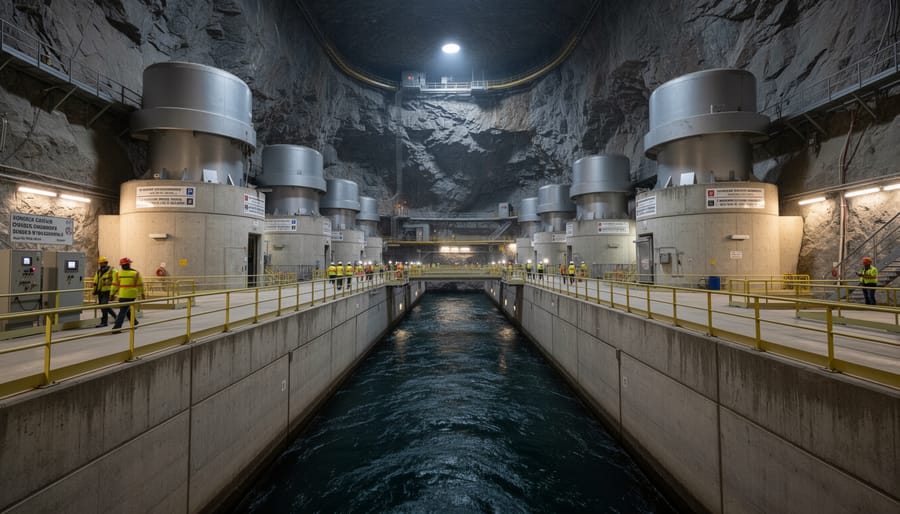
Modern underground hydropower stations take this further by housing entire generating facilities in carved-out caverns. Manitoba’s Keeyask project exemplifies this approach, with turbines installed in chambers hollowed from bedrock to minimize surface disruption. The underground placement protects equipment from temperature extremes, reduces noise impact on nearby communities, and preserves above-ground landscapes for traditional land use.
Modern Innovations in Underground Hydro Design
Modern underground hydroelectric design has shifted dramatically from the concrete-heavy approaches of the 1960s and ’70s. Engineers now prioritize fish-friendly turbine placements, reduced excavation footprints, and modularity that allows components to be lowered into smaller tunnel bores rather than blasting out massive chambers.
One notable advance is the use of compact bulb turbines housed in relatively shallow underground passages. These units sit closer to the water’s natural flow path, eliminating the need for long, deep diversion tunnels that fragment aquatic habitat. In British Columbia, several run-of-river projects have adopted this configuration, cutting excavation volumes by nearly half while maintaining power output.
Another innovation involves prefabricated tunnel linings that slot together underground, minimizing on-site concrete pours and the associated carbon emissions. Quebec’s recent retrofits of aging hydroelectric tunnels have demonstrated how these modular systems can extend infrastructure life without major new excavation, preserving surrounding ecosystems and reducing construction timelines.
Environmental monitoring has also moved underground. Sensor arrays embedded in tunnel walls now track water temperature, sediment flow, and structural integrity in real time, allowing operators to adjust flows dynamically to protect downstream habitats. This integration of data and design represents a fundamental rethinking of how underground hydro infrastructure interacts with the natural world above it, proving that power generation and environmental stewardship can coexist beneath Canadian bedrock.
Wind Energy: Underground Foundations and Grid Connections
Storing Wind Energy in Underground Caverns
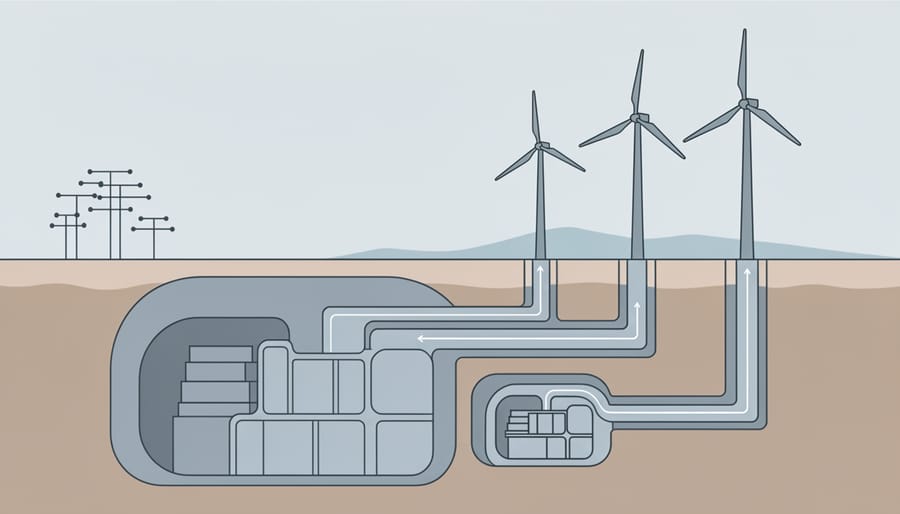
Wind turbines generate power when the wind blows, but what happens when demand peaks at different times? Canada’s answer increasingly lies hundreds of meters underground, where massive caverns transform surplus wind energy into compressed air, ready to release power when it’s needed most.
Compressed air energy storage (CAES) works elegantly: excess electricity from wind farms drives compressors that push air into underground salt caverns or depleted natural gas reservoirs. When demand rises, that compressed air is released, heated, and forced through turbines to generate electricity. A single cavern can store enough energy to power thousands of homes for hours.
Ontario and Alberta are exploring CAES facilities near existing wind farms, leveraging their unique geology. Salt formations in these regions create naturally sealed chambers that don’t leak air, a critical requirement for efficient storage. Unlike batteries that degrade over time, these underground caverns can cycle energy for decades without losing capacity.
The tunneling and drilling expertise that built Canada’s oil and gas infrastructure now adapts to renewable energy storage. Engineers bore access shafts and create solution-mined caverns by dissolving salt formations with water, a proven technique that minimizes environmental disruption at the surface.
Beyond compressed air, some projects experiment with pumped hydroelectric storage using underground reservoirs, and gravity-based systems that lower weighted blocks into mine shafts during surplus generation, then raise them to produce power on demand. These innovations turn Canada’s subsurface into a massive battery, smoothing wind energy’s natural variability and making renewable power reliable around the clock.
Solar Energy: Underground Storage and Distribution
Borehole Thermal Energy Storage: Canada’s Solar Secret
Canada has discovered an ingenious way to solve solar energy’s biggest challenge: what to do when the sun shines in July but you need heat in January. Enter borehole thermal energy storage (BTES), a technology that treats the earth beneath our feet like a massive battery for solar heat.
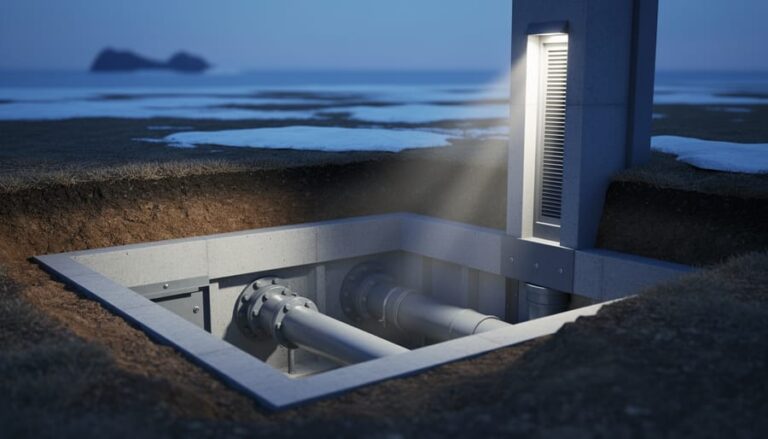
Here’s how it works: during summer, solar collectors capture heat and pump it into a field of boreholes drilled 15 to 100 metres underground. The surrounding rock and soil absorb this warmth, creating a thermal reservoir that holds onto the heat for months. When winter arrives, the system reverses, extracting that stored warmth to heat buildings above.
The Drake Landing Solar Community in Okotoks, Alberta pioneered this approach at a neighbourhood scale. Since 2007, this development of 52 homes has achieved over 90% of its space heating from solar energy year-round. That’s remarkable for a province where January temperatures regularly plunge below minus 20 degrees Celsius. The secret lies in 144 boreholes, each 37 metres deep, that collectively store enough summer heat to carry residents through winter.
Similar systems are emerging at institutional scales. University campuses and hospital complexes across Ontario and British Columbia are installing BTES systems that slash natural gas consumption while smoothing out the seasonal mismatch between solar abundance and heating demand. The technology proves that with smart underground engineering, Canadian solar can compete even in our coldest months.
Biomass and Bioenergy: Below-Ground Potential
Biomass energy might conjure images of burning wood or crop waste, but Canada’s most innovative bioenergy projects are happening underground. Beneath landfills across the country, networks of perforated pipes capture methane-rich biogas before it escapes into the atmosphere. These subsurface collection systems feed anaerobic digesters that convert organic waste into renewable energy while the breakdown process itself occurs in sealed underground chambers designed to optimize bacterial activity.
The science beneath sustainable biomass starts with soil. Canadian research into mycorrhizal networks, the fungal highways connecting tree roots underground, is revealing how healthy subsurface ecosystems accelerate biomass growth while sequestering carbon. Energy crop cultivation increasingly relies on understanding what happens below ground level, where root systems and soil microbes determine how much carbon a biomass project actually offsets.
- Anaerobic Digestion
- The breakdown of organic matter by bacteria in oxygen-free environments, typically in sealed underground tanks, producing biogas that can generate electricity or heat.
- Landfill Gas Extraction
- The process of capturing methane and carbon dioxide from decomposing waste using underground pipe networks, converting a greenhouse gas problem into renewable energy.
- Mycorrhizal Networks
- Underground fungal systems that connect plant roots, facilitating nutrient exchange and carbon storage while supporting the growth of biomass energy crops.
- Carbon Sequestration
- The long-term storage of carbon dioxide in soil, roots, and underground biomass, offsetting emissions from energy production.
Quebec’s agricultural digesters represent this integration at its best. Farms install underground tanks where manure and crop residues decompose, generating biogas while the nutrient-rich digestate returns to fields through subsurface irrigation systems. The setup keeps odours contained and creates a closed loop that strengthens soil health.
Making biomass truly renewable requires resource advocacy that considers the full underground picture. Projects succeed when community engagement includes soil scientists alongside engineers, ensuring biomass production builds rather than depletes the subsurface systems that make it sustainable. The real potential lies not just in what we grow above ground, but in nurturing the hidden biological processes beneath our feet.
How You Can Support Canada’s Renewable Energy Future
Canada’s renewable energy future isn’t just about massive infrastructure projects, it’s built on the collective actions of individuals and communities. You have more power to shape this transition than you might realize.
Start by exploring community energy programs in your province. Many municipalities offer cooperative solar projects where residents collectively invest in renewable installations, sharing both costs and benefits. British Columbia’s community solar gardens and Ontario’s community power programs let you support clean energy even if you can’t install panels on your own roof.
Advocate for renewable energy in local development decisions. When your municipality reviews new construction projects or infrastructure plans, show up to public consultations and ask questions about renewable integration. Is there potential for district geothermal systems? Could new developments incorporate borehole thermal storage? Your voice matters in these decisions.
Consider joining or starting a renewable energy advocacy group in your area. These grassroots organizations influence policy, educate neighbours, and often partner with engineering firms to identify opportunities for local projects. They’re also excellent places to learn about the underground infrastructure that makes renewable energy reliable.
If you’re passionate about the technical side, engage with research communities exploring Canada’s renewable potential. SubterraPulse welcomes curious minds interested in how underground infrastructure enables sustainable energy. Whether you’re sharing local knowledge about geological conditions or learning about tunneling innovations, your participation strengthens the collective understanding needed to build resilient energy systems.
Every conversation, vote, and investment choice moves Canada closer to a truly renewable future, one that honours both the land above and the infrastructure beneath.
Canada’s renewable energy future isn’t just about what we see on the horizon, wind turbines spinning against prairie skies or solar panels gleaming on rooftops. The real transformation is happening beneath our feet, in the tunnels, wells, and caverns that make these technologies work at scale.
We’ve explored how geothermal wells tap Earth’s heat, how massive tunnel networks power our hydroelectric grid, how underground caverns store wind energy for calm days, how borehole systems bank summer solar warmth for winter, and how subsurface facilities convert biomass into usable power. Each of these five renewable sources relies on sophisticated underground infrastructure that Canadian engineers and tunneling experts continue to refine.
This isn’t a distant vision. Communities across Canada are already benefiting from these integrated systems, reducing emissions while creating jobs and building resilience. The expertise we’ve developed in underground construction, from mining operations to urban transit, positions us uniquely to lead this transition.
Your role matters. Whether you advocate for renewable projects in your municipality, participate in community energy programs, or simply learn more about the infrastructure supporting your power grid, you’re part of this shift. The tunnels being dug today and the geothermal wells being drilled this year will serve Canadians for generations.
Canada’s sustainable energy future is being built right now, one underground project at a time.






+ There are no comments
Add yours